
Money as Debt: The Hidden Architecture of Economic Control
Society is shaped by institutions—political, legal, religious, familial, and occupational. Of all these structures, none is more taken for granted, more poorly understood, and more consequential than the monetary system. Most people never ask how money is created, who controls its issuance, or how its design shapes daily life. Yet money is the medium through which nearly every other institution operates. Understanding it is essential to understanding why economic outcomes look the way they do.
The established monetary institution exists as one of the most unquestioned forms of faith there is. How money is created, the policies by which it is governed, and how it truly affects society remain unregistered interests for the great majority of the population.
Yet in a world where 1% of the population owns 40% of the planet’s wealth, where 34,000 children die every single day from poverty and preventable diseases, and where 50% of the world’s population lives on less than $2 a day, one thing is clear: something is very wrong. Whether we are aware of it or not, the lifeblood of all our established institutions—and thus of society itself—is money. Understanding this institution of monetary policy is therefore critical to understanding why our lives are the way they are.
Economics is often viewed with confusion and boredom. Endless streams of financial jargon coupled with intimidating mathematics quickly deter people from attempting to understand it. The fact is that the complexity associated with the financial system is a mere mask, designed to conceal one of the most socially paralyzing structures humanity has ever endured.
How Money Is Created
A number of years ago the Central Bank of the United States, the Federal Reserve, produced a document entitled Modern Money Mechanics. This publication detailed the institutionalized practice of money creation as utilized by the Federal Reserve and the web of global commercial banks it supports. On the opening page the document states its objective: “The purpose of this booklet is to describe the basic process of money creation in a fractional reserve banking system.”
A translation of the process goes something like this.
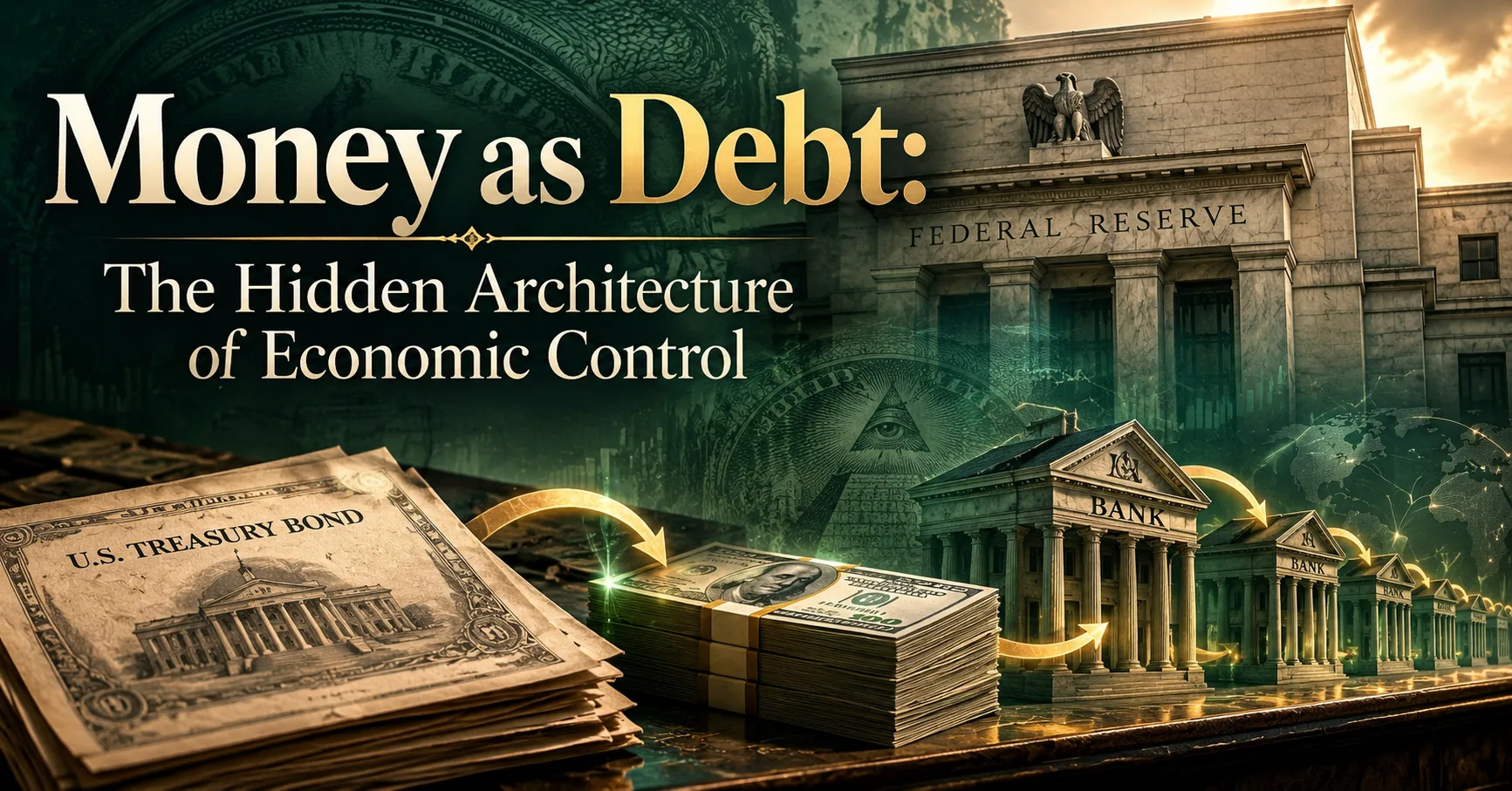
The United States government decides it needs money and calls the Federal Reserve to request, say, $10 billion. The Fed replies that it will buy $10 billion in government bonds. The government takes pieces of paper, paints official-looking designs on them, calls them Treasury Bonds, assigns them a value of $10 billion, and sends them to the Fed. In turn the Fed draws up its own impressive pieces of paper—Federal Reserve Notes—also designating a value of $10 billion. The notes are traded for the bonds. The government then deposits the $10 billion in Federal Reserve notes into a bank account. Upon that deposit the notes become legal tender, adding $10 billion to the U.S. money supply.
Of course the example is a generalization. In reality the transaction occurs electronically, with no paper used at all. Only about 3% of the U.S. money supply exists in physical currency. The other 97% exists essentially in computers alone.
Government bonds are, by design, instruments of debt. When the Fed purchases these bonds with money it essentially created out of thin air, the government is promising to pay that money back to the Fed. In other words, the money was created out of debt. This is the mind-numbing paradox: how money, or value, can be created out of debt, or liability.
The Multiplier Effect
Once the $10 billion sits in a commercial bank account, the process accelerates. Under fractional-reserve rules a bank must maintain legally required reserves equal to a prescribed percentage of its deposits. At the time the Fed document was written, the reserve requirement against most transaction accounts was 10%. With a $10 billion deposit, $1 billion is held as required reserves while the other $9 billion is considered excess and can be used as the basis for new loans.
It is logical to assume that this $9 billion comes out of the existing $10 billion deposit. That is not the case. What really happens is that the $9 billion is simply created out of thin air on top of the existing deposit. This is how the money supply is expanded.
As Modern Money Mechanics states: “Of course they [the banks] do not really pay out loans from the money they receive as deposits. If they did this, no additional money would be created. What they do when they make loans is to accept promissory notes in exchange for credits to the borrowers’ transaction accounts.”
The newly created $9 billion is loaned out and, in most cases, re-deposited somewhere in the banking system. That deposit becomes new reserves. Ten percent is isolated; 90%—$8.1 billion—becomes available for still more loans. The cycle repeats: $7.29 billion, $6.56 billion, $5.90 billion, and so on. The deposit-money-creation-loan cycle can technically continue toward infinity. The average mathematical result is that about $90 billion can be created on top of the original $10 billion. For every deposit that occurs in the banking system, roughly nine times that amount can be created out of thin air.
What Gives the New Money Value?
A logical yet elusive question follows: what actually gives this newly created money value?
The new money essentially steals value from the existing money supply. The total pool of money is increased irrespective of the demand for goods and services. As supply and demand find equilibrium, prices rise, diminishing the purchasing power of each individual dollar. This is generally referred to as inflation, and inflation is essentially a hidden tax on the public.
As one observer put it: the advice generally given is to “inflate the currency.” They do not say debase the currency, devalue the currency, or cheat the people who have saved. They say lower the interest rates. The real deception is the distortion of the value of money. When money is created out of thin air, there are no prior savings, yet there is so-called capital.
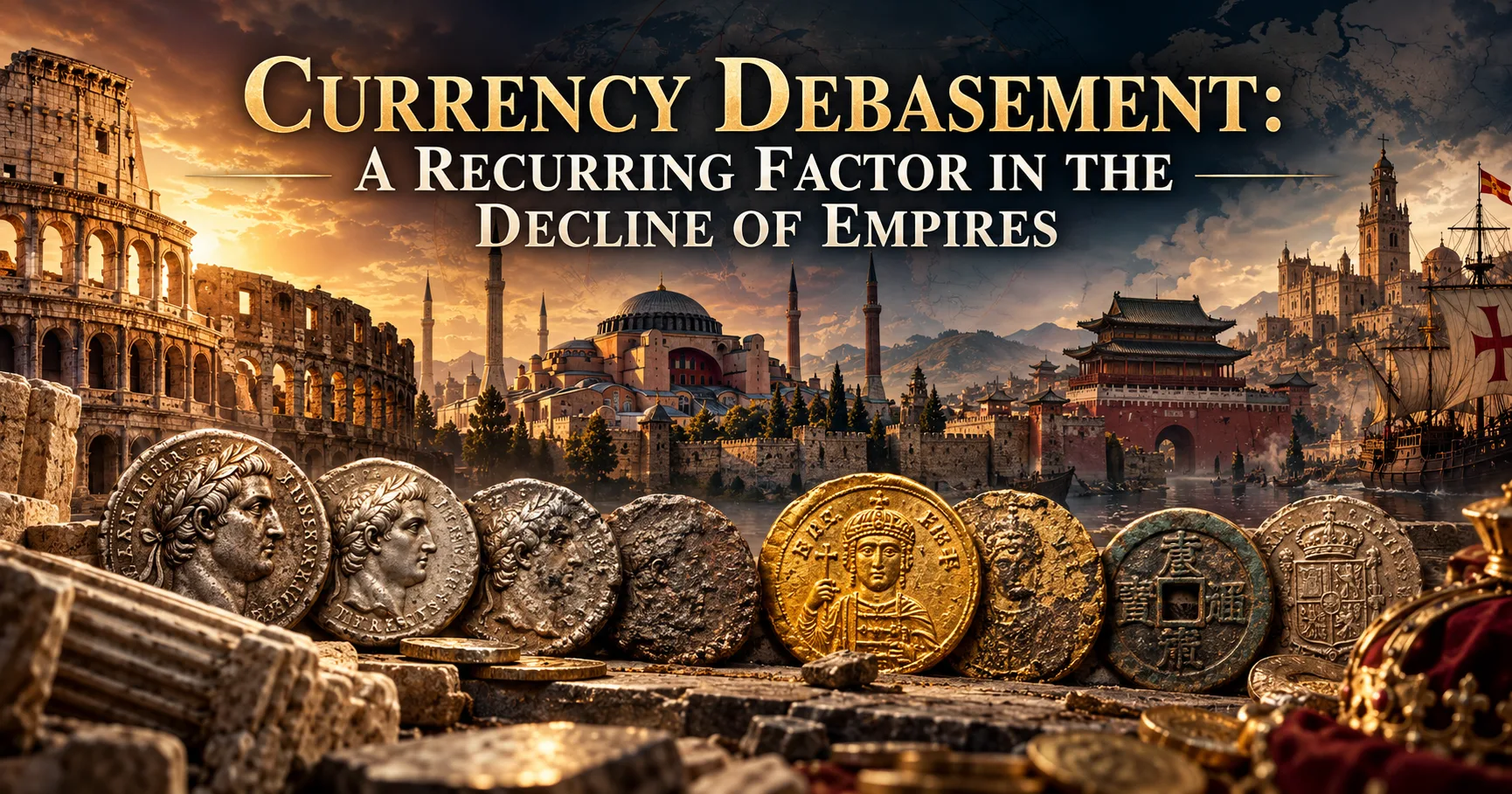
The fractional-reserve system of monetary expansion is inherently inflationary. Expanding the money supply without a proportional expansion of goods and services will always debase a currency. A glance at the historical value of the U.S. dollar versus the growth of the money supply reflects this inverse relationship definitively. One dollar in 1913 required $21.60 in 2007 to match its purchasing power—a 96% devaluation since the Federal Reserve came into existence.
Money Is Debt and Debt Is Money
If the reality of inherent and perpetual inflation seems absurd and economically self-defeating, hold that thought—because absurdity is an understatement regarding how the financial system really operates. In our financial system, money is debt and debt is money.
Charts of the U.S. money supply and the U.S. national debt from 1950 to 2006 show trends that are virtually identical. The more money there is, the more debt there is; the more debt there is, the more money there is. Every single dollar in circulation is owed by somebody to somebody. The only way money comes into existence is through loans. Therefore, if everyone in the country were able to pay off all debts—including the government—there would not be one dollar in circulation.
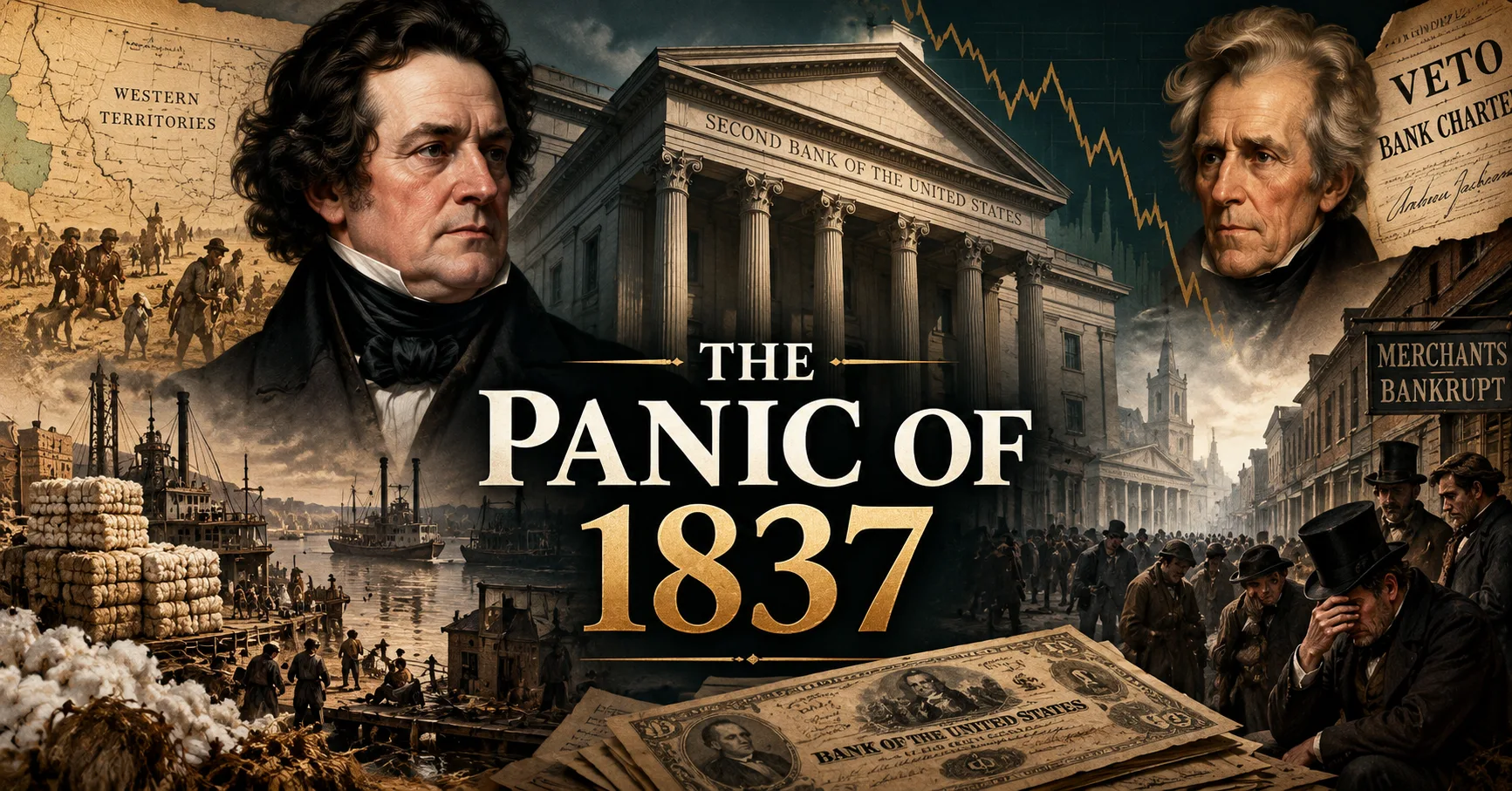
The last time in American history the national debt was completely paid off was in 1835, after President Andrew Jackson shut down the central bank that preceded the Federal Reserve. Jackson’s entire political platform essentially revolved around his commitment to end that institution. He warned that the bold efforts the bank had made to control the government were but premonitions of the fate that awaited the American people should they be deluded into perpetuating it or establishing another like it. His message was short-lived. International banking interests succeeded in installing another central bank in 1913—the Federal Reserve. As long as this institution exists in its present form, perpetual debt is guaranteed.
The Missing Interest
So far we have seen that money is created out of debt through loans, that those loans are based on reserves derived from deposits, and that through the fractional-reserve system any deposit can support roughly nine times its original value, debasing the existing money supply and raising prices. Yet one critical element has been omitted—the element that reveals the truly fraudulent nature of the system itself: the application of interest.
When the government borrows from the Fed, or when a person borrows from a bank, the sum must almost always be paid back with accrued interest. Nearly every dollar that exists must eventually be returned to a bank with interest paid as well. But if all money is borrowed from the central bank and expanded by commercial banks through loans, only the principal is created in the money supply. Where, then, is the money to cover all of the interest that is charged?
It does not exist.
The ramifications are staggering. The amount of money owed back to the banks will always exceed the amount of money available in circulation. This is why inflation is a constant: new money is always needed to help cover the perpetual deficit built into the system by the need to pay interest. It also means that, mathematically, defaults and bankruptcy are built into the system. There will always be pockets of society that get the short end of the stick.
An analogy is a game of musical chairs. Once the music stops, somebody is left without a seat. That is the point. The system invariably transfers true wealth from the individual to the banks. If you are unable to pay your mortgage, they take your property. This is particularly enraging when one realizes that not only is such a default inevitable given the fractional-reserve practice, but the money the bank loaned to you did not even legally exist in the first place.
A Courtroom Revelation
In 1969 a Minnesota court case involved a man named Jerome Daly who challenged the foreclosure of his home by the bank that had provided the loan. His argument was that the mortgage contract required both parties to put up a legitimate form of property for the exchange—what the law calls consideration. Daly explained that the money was not the property of the bank; it had been created out of nothing as soon as the loan agreement was signed.
The bank’s president, Mr. Morgan, took the stand. In the judge’s personal memorandum he recalled that the bank president admitted that, in combination with the Federal Reserve Bank, the bank had created the money and credit upon its books by bookkeeping entry. The money and credit first came into existence when they created it. Mr. Morgan further admitted that no United States law or statute existed which gave him the right to do this. A lawful consideration must exist and be tendered to support the note. The jury found there was no lawful consideration, and the judge agreed. He added, poetically: “Only God can create something of value out of nothing.”
Upon this revelation the court rejected the bank’s claim for foreclosure, and Daly kept his home. The implications of the decision are immense. Every time money is borrowed from a bank—whether a mortgage or a credit-card charge—the money given is not only created as a bookkeeping entry; it is an illegitimate form of consideration that, strictly speaking, voids the contract to repay, because the bank never had the money as property to begin with. Such legal realizations have been suppressed and ignored. The game of perpetual wealth transfer and perpetual debt continues.
Why the System Persists
During the American Civil War, President Lincoln bypassed the high-interest loans offered by European banks and decided to do what the founding fathers had advocated: create an independent and inherently debt-free currency. It was called the greenback. Shortly after this measure was taken, an internal document circulated between private British and American banking interests stated the concern plainly: while the European plan is that capital shall control labor by controlling wages, this can be done by controlling the money. “It will not do to allow the greenback, as we cannot control that.”
The fractional-reserve policy perpetrated by the Federal Reserve, which has spread in practice to the great majority of banks in the world, functions as a system of modern slavery. Money is created out of debt. What do people do when they are in debt? They submit to employment to pay it off. But if money can only be created out of loans, how can society ever be debt-free? It cannot. And that is the point.
The fear of losing assets, coupled with the struggle to keep up with the perpetual debt and inflation inherent in the system, compounded by the inescapable scarcity within the money supply itself—created by the interest that can never be fully repaid—keeps the wage slave in line, running on the hamster wheel with millions of others, in effect powering an empire that truly benefits only the elite at the top of the pyramid. At the end of the day, who are you really working for? The banks. Money is created in a bank and invariably ends up in a bank. They are the true masters, along with the corporations and governments they support.
Physical slavery required people to be housed and fed. Economic slavery requires people to feed and house themselves. It is one of the most ingenious scams for social manipulation ever created. At its core it is an invisible war against the population. Debt is the weapon used to conquer and enslave societies, and interest is its prime ammunition.
While the majority walks around oblivious to this reality, the banks, in collusion with governments and corporations, continue to perfect and expand their tactics of economic warfare, spawning new institutions such as the World Bank and the International Monetary Fund, and inventing a new type of soldier: the economic hitman.
Seeing the Structure Clearly
None of the above is inevitable in the abstract. Different monetary arrangements have existed and remain possible—arrangements that do not require every unit of currency to enter circulation as an interest-bearing debt. Whether any society chooses to examine those alternatives depends first on recognizing how the present system actually works.
The monetary institution is not a neutral backdrop. It is an active structure that shapes incentives, distributes risk, and determines who must work, who must borrow, and who ultimately owns the assets produced. The complexity of financial language has long served as a barrier to that recognition. Once the accounting is made visible, the core process is not especially complicated: money is created as debt; interest ensures that total claims exceed the money created; inflation and defaults transfer purchasing power and assets; and the system requires continuous expansion or continuous distress.
Seeing the mechanism clearly is the necessary first step toward any informed judgment about it.