
Currency Debasement: A Recurring Factor in the Decline of Empires
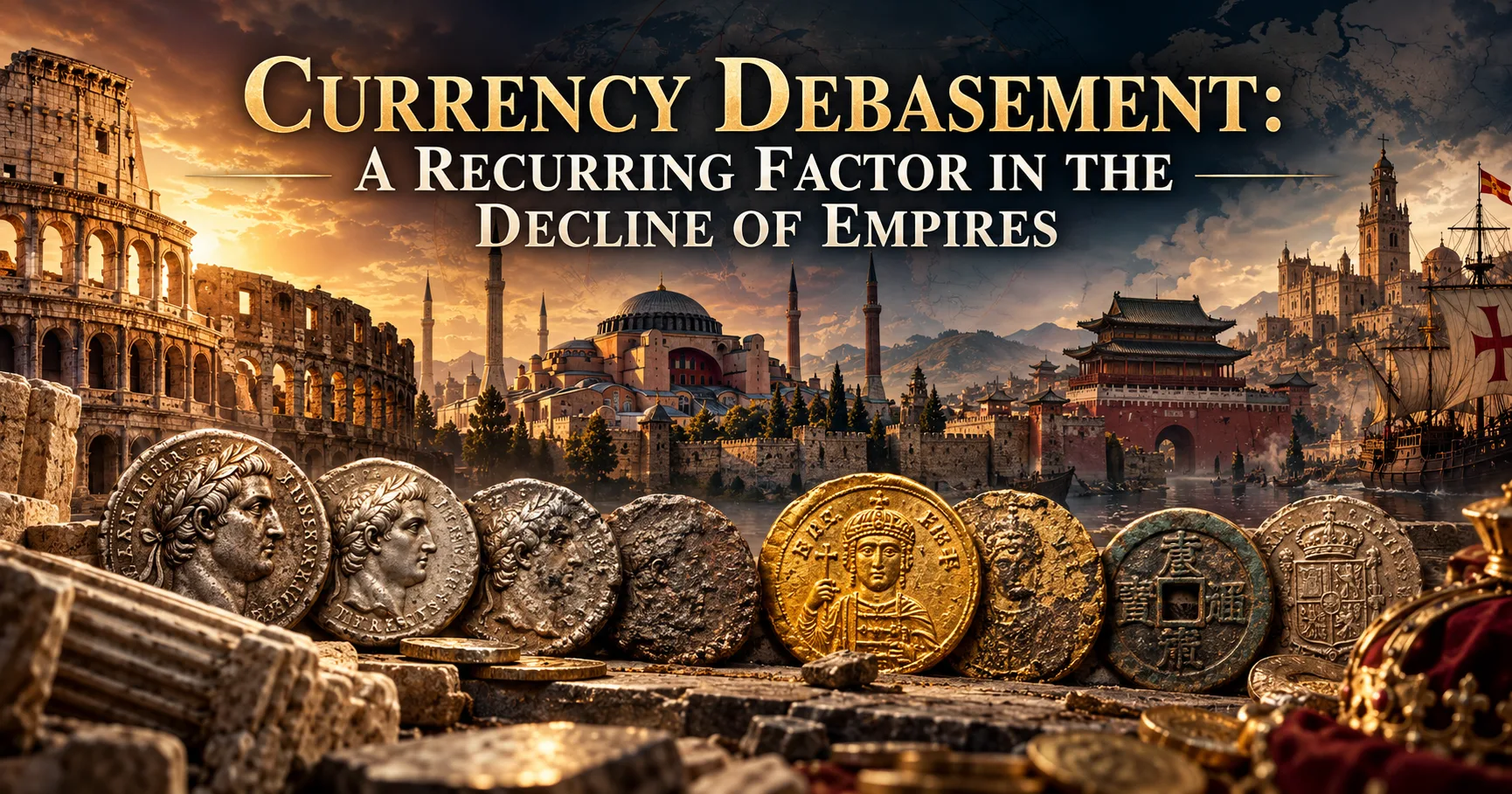
Major empires rarely collapse for a single reason. Military overextension, administrative decay, external pressure, demographic shocks, and institutional failure all contribute. Yet across widely separated times and places, one pattern appears with striking regularity: when fiscal pressures mounted, rulers debased the currency. The debasement did not by itself destroy these empires, but it repeatedly weakened their economic foundations, eroded confidence, and made daily life harder for ordinary people. It was a common and significant contributing factor in their decline. The Byzantine experience is especially instructive because it includes both a long period of monetary stability, a serious debasement, a deliberate restoration of sounder currency, and a later return to debasement.
Rome
The Roman denarius began as a high-quality silver coin. Over centuries its precious-metal content was progressively reduced. The process accelerated during the Crisis of the Third Century, when civil war, invasions, and rising military costs strained imperial finances. By the late 260s many coins that still circulated as “silver” contained only a few percent silver, often little more than a thin surface wash over base metal.
For common people the effects were immediate and harsh. Prices of basic goods, especially food, rose sharply. Wage earners and urban residents found that their pay bought less bread, oil, and other necessities. Soldiers demanded higher nominal pay that still failed to keep pace with costs. Better-quality older coins disappeared from circulation as people hoarded them, leaving the marketplace flooded with inferior money. In many areas ordinary transactions became more difficult; some communities drifted toward barter and local subsistence. Long-distance trade contracted. When Diocletian issued his Edict on Maximum Prices in 301, attempting to freeze the cost of hundreds of goods and services under threat of severe penalties, the controls largely failed. Goods vanished from open markets into black markets, shortages worsened, and the urban poor suffered most. Debasement did not cause every hardship of the third century, but it systematically reduced the real value of wages and savings and disrupted the everyday exchange on which ordinary life depended.
Byzantium: Stability, Collapse, Restoration, and Renewal of Debasement
The Byzantine Empire inherited and refined the late Roman gold solidus, known as the nomisma. For roughly seven centuries this coin maintained exceptionally high purity—typically 95–98 percent gold—and served as a trusted international standard. Its reliability supported trade, taxation, and daily economic life across a complex society.
That standard began to erode in the eleventh century. Gradual debasement accelerated after the defeat at Manzikert in 1071. By the early years of Alexios I Komnenos the once-pure gold coin had fallen to roughly 10 percent gold or less. In 1092 Alexios carried out a major reform, introducing the hyperpyron—a gold coin of substantially restored fineness (around 85–90 percent gold)—and a clearer system of denominations. The reform re-established a relatively sound currency that provided stability for about a century.
The restoration did not last indefinitely. After the Fourth Crusade and during the later centuries of the empire, gold content declined again. By the fourteenth century the hyperpyron had been significantly debased. Contemporary accounts and later records indicate that continuous devaluations were followed by sharp rises in food prices. The lower classes suffered widespread hardship and hunger as the purchasing power of everyday money fell. Ordinary households found that the coins they received for labor or small trade bought steadily less of the staples they needed. The empire faced overwhelming military and political pressures; renewed debasement was one of the ways those pressures appeared in daily economic life, further straining the population already burdened by war and contraction.
China and Spain
China’s repeated experiments with paper money produced similar pressures on common people. When notes were over-issued under the Yuan and early Ming, confidence collapsed. Prices rose, the notes lost value rapidly, and ordinary exchange became unreliable. People who held the paper saw their purchasing power evaporate; markets grew disordered at the very moment political authority was weakening.
In Spain, the massive inflow of American silver and later debasements of copper coinage contributed to prolonged inflation. Real wages for many workers stagnated or fell even as nominal prices climbed. Artisans, laborers, and small producers faced higher costs for food and materials while their own earnings lagged. The crown’s fiscal difficulties and repeated monetary manipulations added uncertainty to everyday transactions and long-term planning.
How Debasement Reached Ordinary Life
Across these cases the harm to common people followed recognizable channels:
Rising prices for food and necessities outpaced wages, shrinking real living standards.
Savings held in coin or notes lost value, punishing thrift.
Better money disappeared from circulation, leaving markets dominated by inferior currency.
Trade and specialized production contracted as the unit of account became unreliable, pushing more people toward local subsistence.
Price controls, when attempted, often created shortages and black markets that hit the poor hardest.
Tax demands continued or intensified even as the money in which people were paid bought less.
These effects did not fall evenly. Those closest to the sources of new money or able to hold real assets suffered less; wage earners, small savers, and urban consumers suffered more. The result was a gradual erosion of the economic security and predictability that ordinary households need.
Conclusion
Stable money is not sufficient to preserve an empire. Unstable money, however, has repeatedly made daily life harder and political order more fragile. Across Rome, Byzantium, imperial China, and early-modern Spain, currency debasement appears as a recurring response to fiscal stress and as a significant factor that deepened economic and social difficulties. The Byzantine example is particularly revealing: a long era of sound currency, a severe collapse, a successful restoration under Alexios I, and eventual return to debasement under later pressures. Debasement did not single-handedly end these empires. It consistently aided their demise by undermining the monetary foundation on which both state power and ordinary livelihoods depended. The pattern is old, and the incentives that produce it have not disappeared.