
Learning Path
Your Learning Journey
Begin with the monetary foundations, follow the core curriculum, then expand into the subjects and questions that interest you most.
Build the Foundation Before Expanding Outward
Monetary ideas become much easier to understand when they are encountered in the right order.
The Academy is designed to introduce the fundamental concepts first, then gradually connect them to banking, financial markets, economic history, and the broader monetary system.
You do not need to complete everything at once. Follow the core curriculum first, take time to understand the major ideas, and then use the rest of the Foundation to investigate the subjects that capture your interest.
Student Learning Road Map
Use this visual as a quick reference for the recommended path through the Academy.
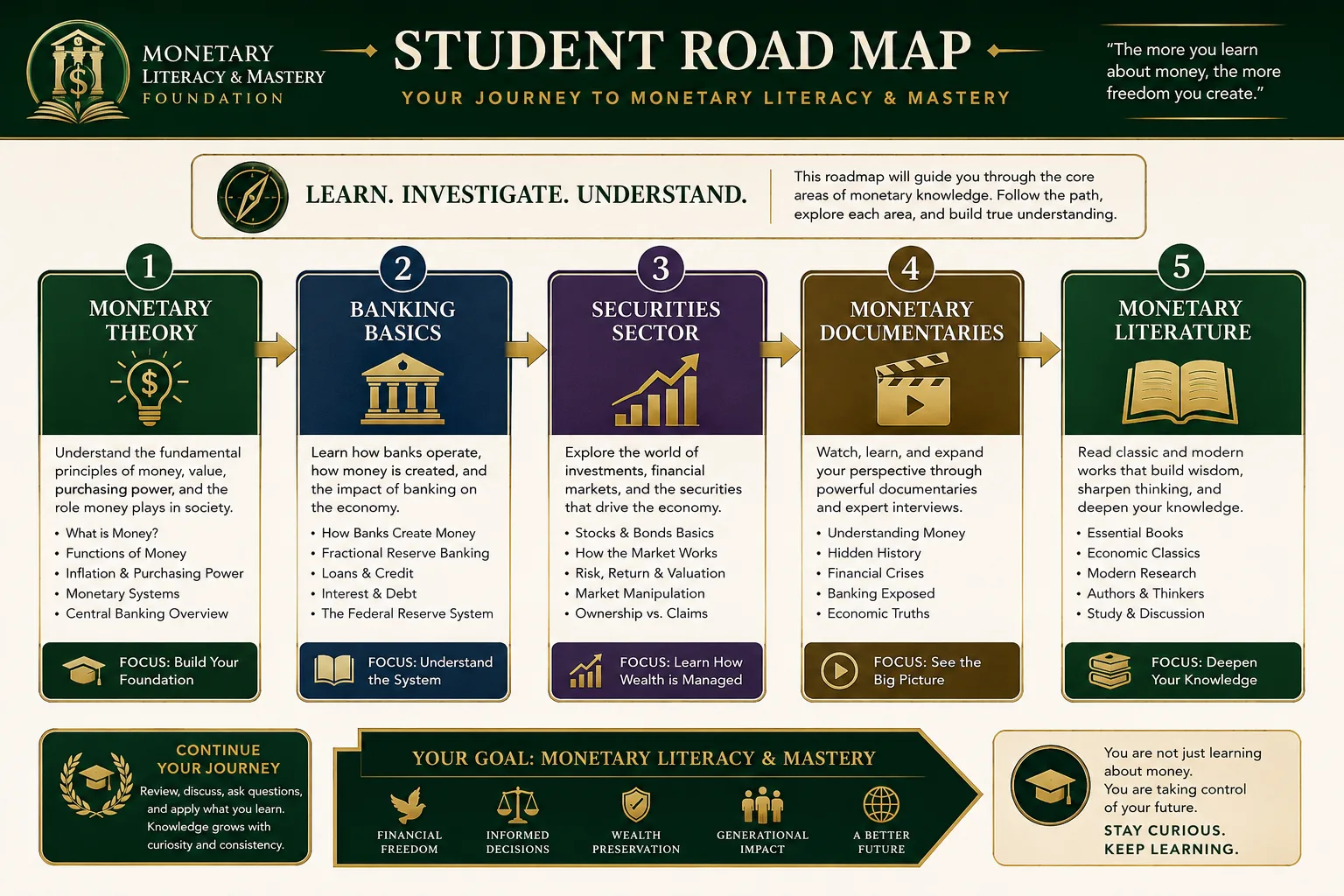
Follow These Three Sections in Order
These lessons establish the concepts that later material assumes you already understand.
Complete the introduction and Lessons 1–6 to establish the basic monetary framework.
Complete Lessons 1–3 to understand deposits, lending, credit creation, and modern banking.
Continue into the introductory securities lesson and connect monetary activity with financial markets.
Don't rush to finish. Focus on understanding how each concept connects to the ideas that came before it.
The Path Opens Up
Once you have completed the foundational curriculum, there is no single required order. This is where the Academy becomes increasingly self-directed.
Choose the format or subject that interests you and continue building connections between monetary theory, history, institutions, markets, and real-world events.
How to Use the Academy
Monetary literacy develops through repeated exposure to ideas from different perspectives. A concept that seems abstract in one lesson may suddenly become clear when you encounter it again in a historical example, documentary, discussion, or simulator.
Begin with the structured lessons and understand the basic mechanism being explained.
Use books, research, documentaries, and historical material to deepen your understanding.
Use simulations, examples, and discussions to see how the ideas behave outside the lesson.
Look for relationships between money, banking, markets, policy, history, and everyday economic life.
Understanding Matters More Than Completion
The Academy is not a race through a checklist of lessons. The goal is to develop a framework for understanding the monetary system.
Take your time. Revisit earlier material. Ask questions. Follow ideas that interest you. Some of the most important connections appear only after you have encountered the same subject from several different perspectives.
Progress is measured by what you understand — not by how quickly you reach the end.
Your Road Map
Monetary Policy → Banking Fundamentals → Securities Markets
Read, watch, experiment, investigate, and revisit important concepts.
Ask questions, compare explanations, and learn from other members.
Once the foundation is established, explore the subjects most relevant to your interests.
Start With Monetary Policy
Your first objective is simple: establish a strong monetary foundation. Begin with the introductory material, work through the lessons in order, and allow each idea to build on the last.