
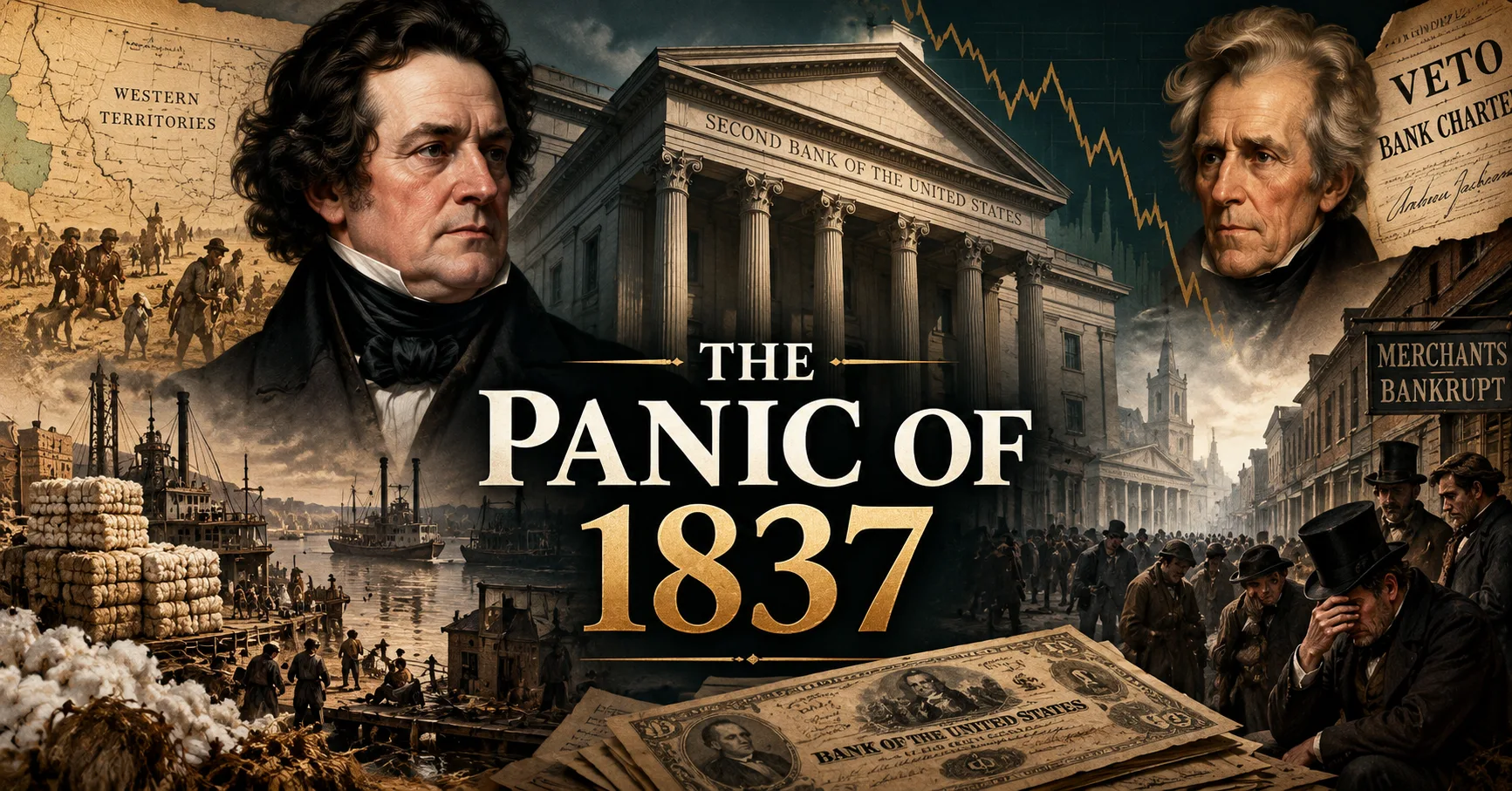

The Second Bank of the United States caused the Panic of 1837 through a deliberate, institution-saving policy reversal that crushed the economy it had previously inflated.
Nicholas Biddle ran the Second Bank through the early 1830s and expanded credit aggressively. Member banks multiplied loans on top of thin specie reserves. Land speculation exploded across the Western frontier, with speculators borrowing paper dollars to buy federal land at $1.25 an acre, betting that cotton prices would stay high forever. Bank notes outstanding roughly tripled between 1830 and 1836. You could feel the apparent prosperity in New Orleans cotton houses and New York dry-goods firms alike.
Andrew Jackson then destroyed the Bank's federal charter in 1832, and Biddle responded by contracting credit sharply, partly to manufacture a crisis he could blame on Jackson politically. Credit tightened. Loans were called. Then, after Jackson's Specie Circular of 1836 demanded hard money for public land purchases, the entire rotten scaffolding collapsed. Banks suspended specie payments in May 1837. Hundreds of merchants failed. Unemployment spiked in the Eastern cities. The contraction ran until 1843.
The lesson free market economists draw from this is that credit expansion without corresponding real savings always ends in liquidation. The boom misdirects capital into ventures that cannot survive without cheap credit. When the lending contracts, those ventures fail, revealing that the prosperity was accounting fiction rather than accumulated wealth.
Biddle's bank created the inflation, manipulated the contraction for political theater, and left ordinary creditors, depositors, and workers to absorb the consequences. Central banking in 1837 performed exactly as central banking performs today.
Related Articles
Discussion0
Log in to join the discussion.
Be the first to comment on this article.