
You Got Richer on the Tax Form—and Nowhere Else
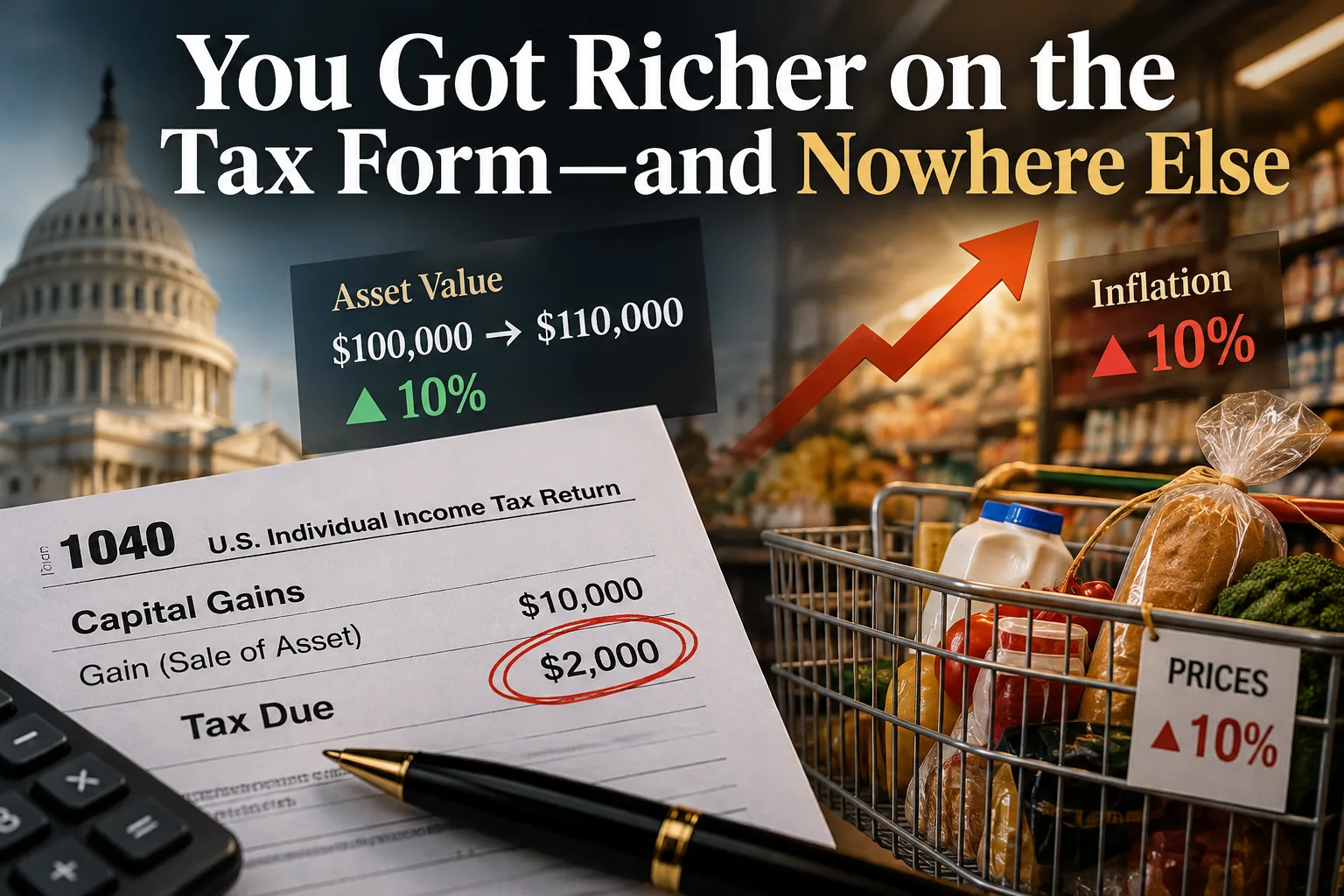
Suppose you buy an asset for $100,000. A year later, it is worth $110,000. On paper, you made $10,000. Your investment rose 10 percent, so it looks like you are 10 percent richer.
Now suppose prices throughout the economy also rose 10 percent during that same period. What changed in real terms? Almost nothing. The $110,000 you have today buys roughly what $100,000 bought when you started. Your account balance increased, but your purchasing power did not.
You did not become 10 percent wealthier. You simply needed 10 percent more currency to maintain the same purchasing power.
Then comes the tax bill.
A Gain in Dollars Is Not Always a Gain in Wealth
This is the difference between a nominal gain and a real gain. A nominal gain tells you how many more dollars you have. A real gain tells you whether those dollars can actually buy more.
If your asset rises by 10 percent and the price level also rises by 10 percent, your real return is effectively zero. You have more dollars, but each dollar buys less. The increase in the number of dollars merely compensates for the decline in what each dollar can purchase.
That distinction matters because the tax system generally measures gains in nominal dollars, not in purchasing power.
If you bought an asset for $100,000 and later sold it for $110,000, the government generally sees a $10,000 capital gain. It does not normally adjust your original $100,000 cost basis upward simply because the dollar lost purchasing power while you owned the asset.
So you can have a taxable profit without having experienced a real economic profit.
You got richer on the tax form and nowhere else.
Then Taxes Can Turn Breaking Even Into Losing Money
Consider the same example. You invest $100,000, the asset rises 10 percent to $110,000, and inflation is also 10 percent.
Before taxes, you have essentially maintained your purchasing power. You are standing still economically.
Now suppose, for illustration, that you owe a 20 percent tax on the $10,000 realized gain. That is a $2,000 tax bill, leaving you with $108,000.
But because prices have risen 10 percent, it now takes $110,000 to buy what $100,000 bought when you started.
Your after-tax $108,000 therefore has less purchasing power than the $100,000 you originally invested. Adjusted back into the purchasing power of the starting year, $108,000 is worth only about $98,182.
Your investment statement says you made money. Your tax return says you made money. You paid tax because you supposedly made money.
Yet you ended with less real purchasing power than you started with.
That is the strange result of taxing nominal gains in a depreciating unit of account.
Your Cost Basis Is Frozen in Yesterday's Dollars
The underlying problem is that your tax basis usually remains expressed in the dollars you originally paid.
Imagine buying an asset for $100,000 many years ago. That $100,000 represented a certain amount of purchasing power at the time. Years later, inflation may mean that it takes $150,000 just to command the same general purchasing power.
If you sell the asset for $150,000, it may look as though you earned a $50,000 profit. In real terms, however, you may simply have preserved the purchasing power of your original investment.
The tax calculation does not necessarily see it that way. It sees an asset purchased for $100,000 and sold for $150,000.
The measuring stick changed, but the tax basis did not.
That can make inflationary compensation look like economic profit.
Asset Prices Can Rise Because the Currency Falls
An asset can increase in price for many legitimate reasons. A company may become more productive. Land may become more desirable. A business may earn more money. Scarcity can increase. Technology can create new value.
But asset prices can also rise partly because the currency in which those assets are measured is losing purchasing power.
A house going from $300,000 to $450,000 does not automatically mean the owner became 50 percent wealthier. If houses, construction, rent, food, energy, labor, transportation, and other necessities all became dramatically more expensive over the same period, the owner may discover that the larger number does not buy nearly as much additional life as it appears to.
The important question is not simply, “How many more dollars do I have?”
It is, “What can those dollars buy compared with before?”
That is the difference between accounting wealth and real wealth.
Inflation Creates a Hurdle Before You Even Make a Profit
This is why investors have to overcome inflation before they have actually increased their purchasing power.
If your investment earns 5 percent while prices rise 4 percent, you did not really become 5 percent wealthier. Your real return is only around 1 percent before taxes.
If taxes are then imposed on the full nominal gain, even that small real return can shrink substantially. In some circumstances, the after-tax real return can become negative.
An investor can therefore satisfy the tax system's definition of profit before satisfying the economic definition of profit.
That is an important distinction because most financial reporting trains people to focus on nominal percentages. A portfolio is “up 8 percent.” A house “gained $50,000.” A stock “doubled.”
Those numbers sound impressive, but without considering the changing purchasing power of the currency, they do not tell you how much wealth was actually created.
A Shrinking Ruler Can Make Everything Look Bigger
Imagine measuring the same table every year with a ruler that gets slightly shorter.
Eventually, the table would measure more “units” even though the table itself had not grown.
Something similar can happen with currency.
If the purchasing power of the dollar declines, it may take more dollars to represent the same real value. The nominal price rises, but part of that rise may simply reflect the shrinking value of the measuring unit.
Now imagine being taxed because the table supposedly got bigger.
That is essentially the concern with taxing inflationary portions of nominal capital gains.
The number increased, so the tax system records a gain. But the increase in the number does not necessarily mean an equivalent increase in economic wealth.
This Is Why Purchasing Power Matters More Than the Number
Wealth is not ultimately about accumulating the largest possible number of dollars.
You cannot eat dollars. You cannot live inside a brokerage statement. A retirement account does not matter because of the number displayed on the screen. It matters because of the housing, food, energy, healthcare, transportation, labor, goods, services, and freedom that those monetary units can command.
That is why purchasing power is the better test of whether you actually became wealthier.
If your asset rises 10 percent while prices rise 10 percent, you did not gain 10 percent in real wealth. Before taxes, you essentially maintained your position.
If you then realize the gain and owe tax on that nominal increase, you can actually finish with less purchasing power than you began with.
The statement says you made money. The tax form says you made money. The government taxes you as though you made money.
But the grocery store, the housing market, the energy bill, and everything else you actually buy may tell a different story.
You got richer on the tax form—and nowhere else.