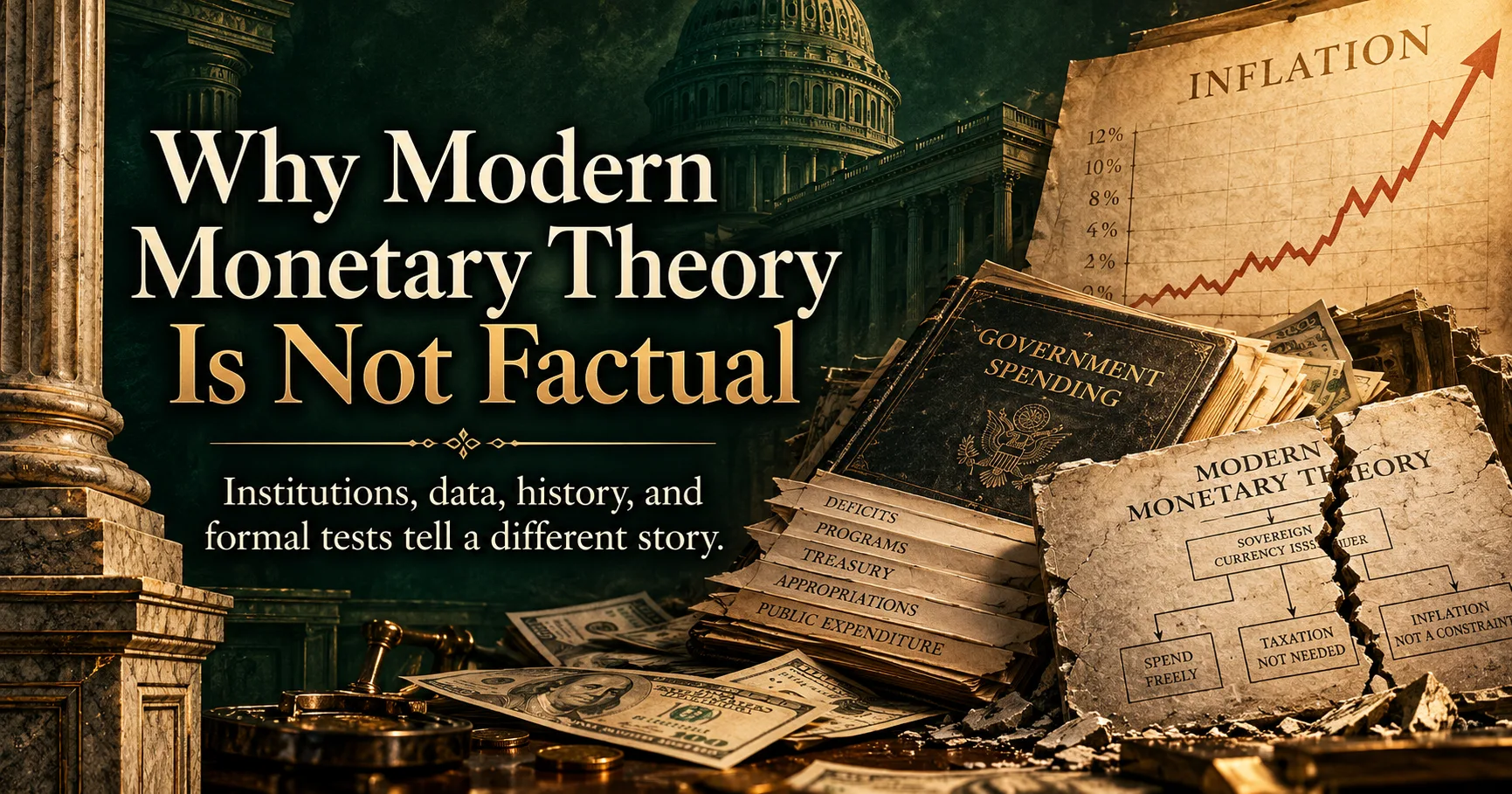

Deficit Spending and the Transfer of Costs to Future Generations
When a government spends more than it collects in revenue, it must cover the difference. The usual methods are borrowing from the public or, in some cases, creating new money. Both approaches allow higher spending today. Both also shift part of the cost onto people who have little or no say in the decision—future taxpayers and future workers. In that precise sense, sustained deficit spending transfers resources from later generations to the present one.
How the Transfer Works
Government borrowing is a claim on future income. When the Treasury issues bonds, it receives money now and promises to pay interest and principal later. Those future payments must come from somewhere. In practice they come from future tax revenues, from further borrowing, or from money creation. Each route imposes costs on people who were not yet voting, working, or in many cases even born when the original spending occurred.
Interest is the most visible channel. As debt accumulates, the annual interest bill grows. In recent years net interest on the U.S. public debt has risen into the hundreds of billions and now competes with major program categories. Every dollar paid in interest is a dollar that cannot be used for other public purposes or left in private hands. Future budgets are therefore more constrained than they otherwise would have been.
A second channel is crowding out. When government borrows heavily in capital markets, it competes with private borrowers for savings. Higher demand for loanable funds can raise interest rates or divert capital that would otherwise have financed private investment in plant, equipment, research, and housing. A smaller private capital stock means lower future productivity and lower real wages than would have prevailed without the diversion. The loss is not always dramatic in any single year, but it compounds over decades.
A third channel appears if the debt is eventually monetized. When a central bank creates money to purchase government debt or to keep interest rates artificially low, the result is often higher inflation. Inflation reduces the real value of existing debt, which can benefit the government as debtor. It also reduces the real value of wages, pensions, and savings held by the public. Those who hold fixed nominal claims—many of them future retirees and ordinary savers—bear the cost.
The “We Owe It to Ourselves” Argument
A common reply is that public debt is not a burden because “we owe it to ourselves.” The statement is true in a narrow accounting sense: the bonds are assets of some citizens or institutions and liabilities of the government that represents all citizens. It does not follow that the debt is costless.
Interest payments still transfer resources from taxpayers as a group to bondholders as a group. If the distribution of bond ownership differs from the distribution of tax burdens, the transfer has real distributional effects. More importantly, the need to service the debt constrains future fiscal choices. Resources devoted to interest cannot be devoted to other uses. And if the debt grows faster than the economy, the ratio of debt service to national income rises, tightening the constraint over time.
Future generations also inherit whatever capital stock and institutional arrangements the present leaves them. Heavy public borrowing that displaces private investment leaves them a smaller productive base. That is a real economic loss, not merely an accounting entry.
Timing and Political Incentives
Deficit spending is attractive precisely because the benefits are immediate and the costs are deferred. Current voters and current officeholders enjoy higher spending or lower taxes today. The higher taxes, higher interest burdens, reduced capital stock, or inflationary pressure appear later. The political incentive is therefore to push costs beyond the next election cycle. Over decades this incentive produces a rising debt trajectory that future cohorts must manage.
The transfer is not always intentional or malicious. Emergencies, wars, and deep recessions can justify temporary deficits. The problem arises when deficits become structural—when spending consistently exceeds revenue even in normal times—and when the resulting debt is allowed to compound. At that point the intergenerational transfer becomes systematic rather than exceptional.
Limits and Clarifications
Not every dollar of public debt reduces future living standards by the same amount. Debt used to finance productive infrastructure that raises future output can, in principle, pay for itself. Debt incurred during a severe downturn may prevent larger permanent losses. The critical variables are the size of the deficit relative to the economy, the duration of the imbalance, the use to which the funds are put, and the response of private saving and investment.
Even with these qualifications, the basic mechanism remains. A government that spends more than it collects today must extract the difference from someone. When it borrows, that someone is largely the future. The larger and more persistent the deficits, the greater the share of future income that is already spoken for before the next generation begins its own work and its own political life.
Conclusion
Deficit spending allows the present to consume or invest resources it has not fully paid for. The unpaid portion becomes a claim on future output. That claim appears as higher debt service, a smaller private capital stock, tighter future budgets, or inflation. In each form, resources are moved from later generations to the current one. The transfer is not always dramatic in any single year, but it is cumulative. A society that treats deficits as a routine instrument of policy is, over time, quietly reallocating the fruits of tomorrow’s labor to today’s expenditures.