

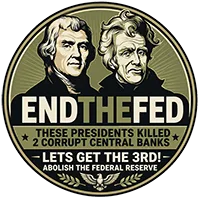
The Federal Reserve
The Federal Reserve occupies a unique position within the American financial system. Supporters describe it as an institution that promotes economic stability, while critics argue it primarily serves the interests of the banking industry. Understanding its structure and role is essential to understanding modern monetary policy.
The Federal Reserve
⏱ 12 Minutes
Intermediate
Federal Reserve • Inflation • Bailouts • Monetary Policy
A Banking Cartel or Public Servant?
The Federal Reserve System is nothing more or less than a banking cartel.
When the Chairman of the Federal Reserve appears before congressional committees to explain monetary policy—whether raising interest rates to combat inflation or lowering them to stimulate the economy—the stated rationale is always the same:
"It's in the best interest of America... for you folks."
In truth, a cartel exists for one purpose only: to advance the interests of its members. The public is not the beneficiary.
Once you understand this fundamental reality, much of recent economic history and the trajectory ahead suddenly comes into sharp focus.
The Mechanics of Money Creation
The Federal Reserve creates money out of nothing.
In one recent week alone, it generated trillions of dollars—money that did not exist before and came from nowhere.
Where does it go?
Primarily to banks, either directly to strengthen their balance sheets or indirectly to entities that owe the banks money, ensuring continued interest payments.
This is not about stimulating the broader economy, creating jobs, or helping homeowners.
It is about preventing the member banks from failing.
Banks can make enormous risky loans to corporations or foreign governments that have little chance of repayment.
When those loans sour, the banks turn to their partners in Congress, warning that failure would collapse the economy, lead to mass unemployment, or invite foreign threats.
The result?
More money created out of thin air to bail them out—all justified as being "for the people."
If new money can be created whenever major financial institutions face significant losses, who ultimately bears the cost?
Timeline of the Modern Monetary System
The Federal Reserve and the modern monetary system did not emerge overnight. The following milestones illustrate how the United States gradually moved away from commodity-backed money toward today's fiat monetary system.
Congress establishes the Federal Reserve System, creating the nation's central banking structure.
Americans are prohibited from owning most monetary gold as the government centralizes gold reserves.
The U.S. dollar becomes the world's reserve currency, backed internationally by gold.
The final convertibility of dollars into gold ends, completing the transition to a fully fiat monetary system.
Extraordinary monetary interventions and bank bailouts dramatically expand the Federal Reserve's role.
The Federal Reserve undertakes one of the largest monetary expansions in modern history.
A Legalized Fraud
The system is built on an accounting sleight of hand that becomes obvious once stripped of banker jargon.
Private banks create money from nothing, lend it to governments, corporations, and individuals, and then collect interest on it.
Imagine the audacity: profiting from funds that never existed until the moment they were typed into existence.
This arrangement was formalized in 1913 with the Federal Reserve Act.
What began as a cartel agreement among competing banks on Jekyll Island was rebranded as official law.
Congress provided the government seal of approval and the enforcement power of the state.
Suddenly, a private banking cartel's rules became binding on the entire nation, backed by the threat of imprisonment for those who defy them.
Many Americans mistakenly believe the Federal Reserve is a government agency because only governments can enforce such rules—but in this case, the government has been co-opted as a partner.
Inflation: The Hidden Tax
The flood of new money into the economy produces inflation.
When the supply of money grows faster than the supply of goods and services, prices rise—not because goods are becoming more expensive, but because the dollar is losing value.
This is a hidden tax, perhaps the most effective one ever devised, because most people do not recognize it as taxation.
Since the Fed's creation in 1913, the U.S. dollar has lost approximately 97% of its purchasing power.
That wealth has been transferred to the government and its banking partners.
If Americans had been forced to pay this amount through direct, visible taxes, revolution would have erupted long ago.
Instead, the slow erosion of purchasing power is tolerated because it is gradual and poorly understood.
If inflation quietly reduces purchasing power every year, how is it different from a tax that is openly collected?
A History of Bailouts
This system includes a built-in "golden parachute" for failing banks: the ability to pass inevitable losses onto taxpayers under the guise of saving the economy.
Bailouts are not new.
They began in earnest decades ago—Penn Central Railroad (1970), Lockheed (1970), New York City (1975), Continental Illinois (1982), and countless others, including loans to third-world nations.
By 2008–2009, the process accelerated dramatically, with hundreds of billions and then trillions created in short order.
These are not rescue packages or economic stimulus.
They are, according to critics of the system, a mechanism for transferring financial losses to the public while preserving the institutions responsible for those losses.
Lesson Summary
The Federal Reserve was established in 1913.
Critics argue it functions as a banking cartel with legal privileges.
The Federal Reserve can expand the money supply through monetary operations.
Inflation reduces the purchasing power of currency over time.
Bailouts transfer financial losses from major institutions to society as a whole.
Understanding the Federal Reserve helps explain modern monetary policy and the incentives behind it.
Understand the Institution Behind Monetary Policy
The Federal Reserve occupies a unique position within the American financial system. Supporters describe it as an institution that promotes economic stability, while critics argue it primarily serves the interests of the banking industry.
Who Benefits From the Current System?
Every monetary system creates incentives. Consider who gains the greatest advantages from today's system and whether those incentives align with long-term economic prosperity.
From Central Banking to Commercial Banking
Throughout the Monetary Foundations section, we've explored what money is, how currency differs from money, how new money is created, why sound money matters, and the role of the Federal Reserve in today's financial system.
Now it's time to shift our attention from the central bank to the institutions most people interact with every day.
In the next section, we'll explore commercial banking—how banks actually operate, what deposits really are, how loans create new currency, and why banks are fundamentally different from what most people believe.
NEXT