
Why Understanding Money Matters
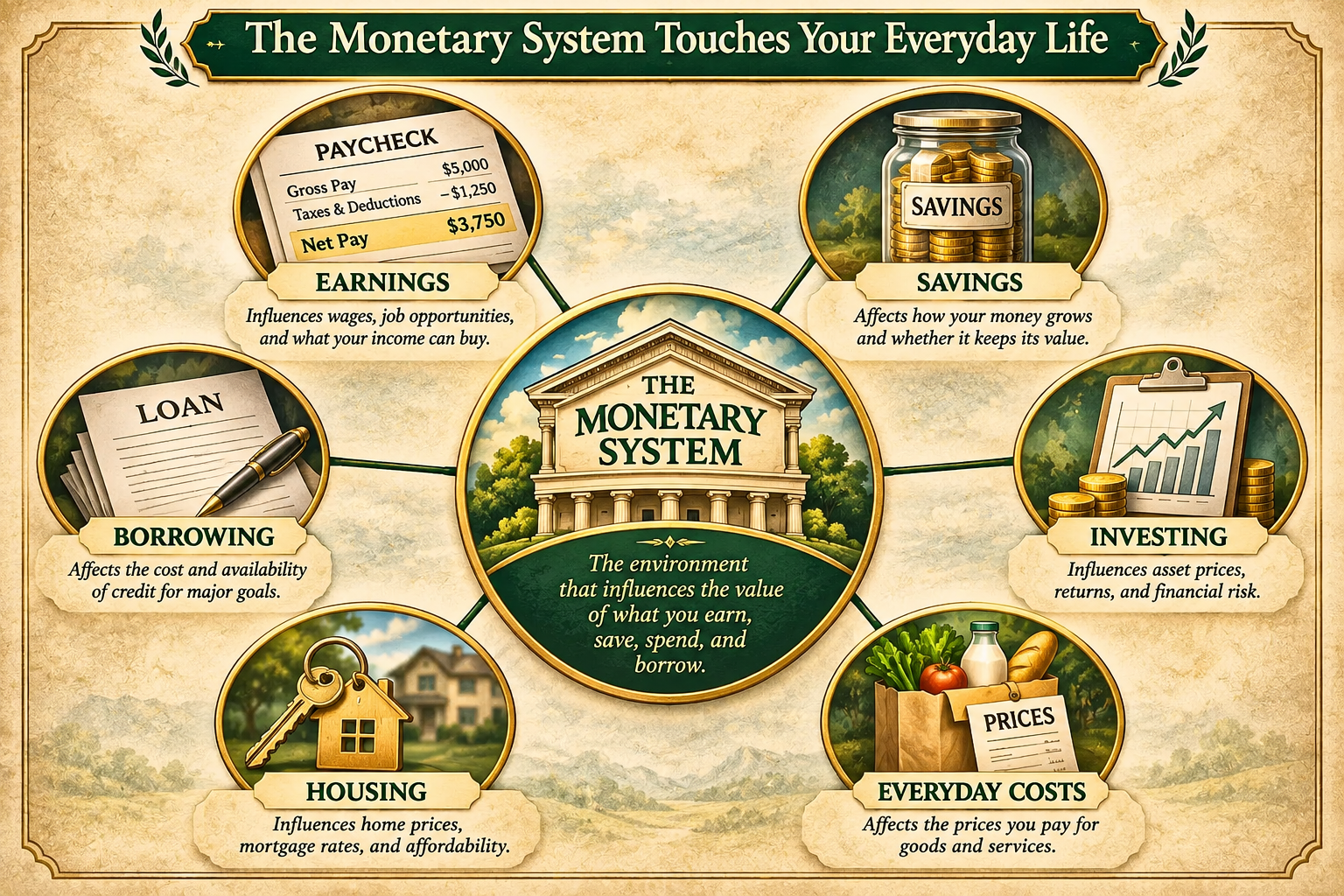
The monetary system affects you whether you understand it or not.
It shapes the value of what you earn, what you save, and what you can afford.
Yet few people understand the mechanisms behind it.
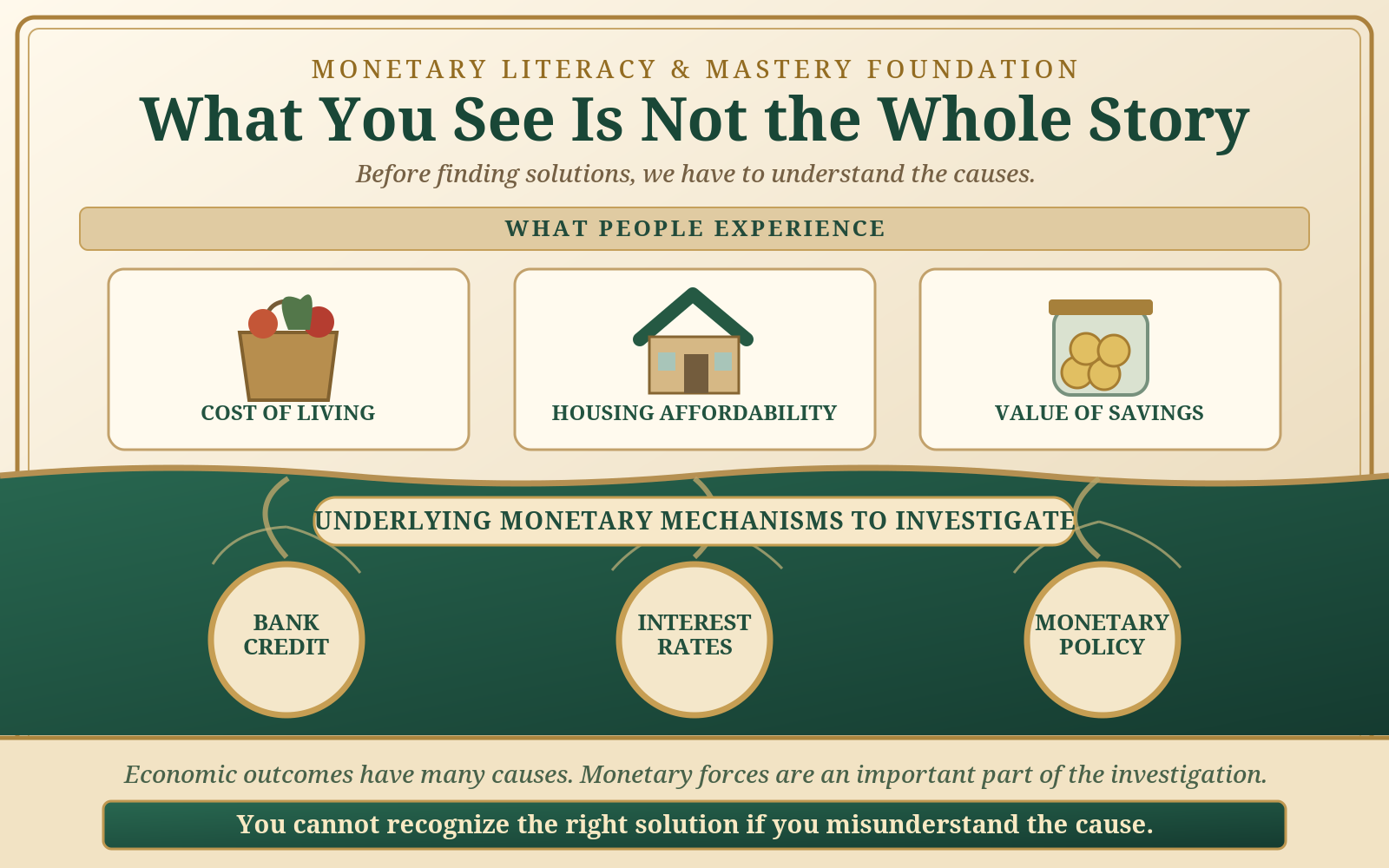
You cannot solve a problem you don't understand. And you cannot recognize
the right economic solution if you misunderstand the cause.
You Know How to Use Money. But Do You Know How It Works?
Most of us are taught to earn a living, pay our bills, save what we can, and plan for the future. Far fewer of us learn where modern money comes from or what changes its purchasing power.
Yet the answers matter whether you follow economics or not. They can help explain why a raise may not feel like progress, why borrowing costs change, and why some people are affected differently by the same monetary decisions.
The Paycheck Test
Imagine you finally receive a well-earned raise. Your paycheck is bigger. Surely you're better off—or are you?
Your annual salary increases from $50,000 to $55,000 , while the overall price level rises 12% during the same period. Did your purchasing power improve or decline?
Reveal the answer →
Your purchasing power actually fell by approximately 1.8%. At the earlier prices, $55,000 now buys about as much as $49,107 did before the price increase. Your paycheck is bigger, but it buys less.
Illustrative calculation: $55,000 ÷ 1.12 ≈ $49,107 in earlier-period dollars. Personal spending patterns and price changes can differ.
This is why understanding money goes beyond simply watching the number on your paycheck or bank statement. What matters is also what that number allows you to do.
Why This Matters to You
The monetary system is not something that exists only in banks, government offices, or economics textbooks. Its effects reach decisions people make every day.
Are you making real progress—or just earning more units of currency?
Will the money you set aside today buy as much when you need it?
Why do interest rates and credit conditions change—and who is affected?
How can monetary conditions influence housing, retirement, and opportunity?
None of these outcomes has a single cause. Wages, prices, housing, and wealth are shaped by many forces. But monetary conditions are an important part of the picture—and one you deserve to understand.
If you knew how money is created and how its value changes, what decisions might you see differently?
You don't need the answer yet. That's what this Academy will help you explore.
Financial Literacy Is Valuable. But It Isn't the Whole Picture.
Budgeting, saving, investing, and managing debt are essential skills. They teach you how to make decisions with the money available to you.
Monetary literacy asks the questions underneath those decisions: What is the monetary unit? Where does it come from? Who can create it? What influences its purchasing power? And how do the rules of the system affect different people?
Understanding the system won't guarantee wealth or protect you from every economic setback. It can, however, give you a better foundation for evaluating claims, recognizing tradeoffs, and making informed decisions.
Seven Questions Worth Knowing the Answers To
You don't have to master everything at once. The Academy builds from approachable questions to the deeper workings of banking, monetary policy, and economic history.
Explore its purposes, properties, and the difference between money and currency.
See how lending creates bank deposits and what constrains the process.
Investigate inflation, prices, credit, and the value of savings.
Study central banks, interest rates, and the Federal Reserve.
Follow how monetary changes can affect groups at different times.
Compare monetary rules, durability, scarcity, trust, and tradeoffs.
Use historical evidence to see how monetary arrangements have changed—and why today's system is not the only one possible.
Along the way, you'll be able to test ideas in interactive simulators, examine primary sources, and question the evidence rather than simply memorizing conclusions.
Money Is Too Important to Remain a Mystery
You don't need to become an economist. You need to know enough to ask good questions, recognize the mechanisms affecting your life, and judge the evidence for yourself.
How Much Do You Already Know?
Before you begin, try the Monetary Literacy Assessment. Think of it as a snapshot of your current understanding, not a test you need to pass. Return to it after studying to see what you've learned—or continue directly to the next introduction.
Take the Monetary Literacy Assessment → NEXT